

Stains · October 2026
Short answer: rust is a chemical stain, so pressure washing alone won't remove it. It takes a rust-specific cleaner that dissolves the iron so it can be rinsed away. In Houston, most orange stains on driveways and walls come from sprinklers running on iron-rich well water, so the stains will come back unless the source is fixed too.
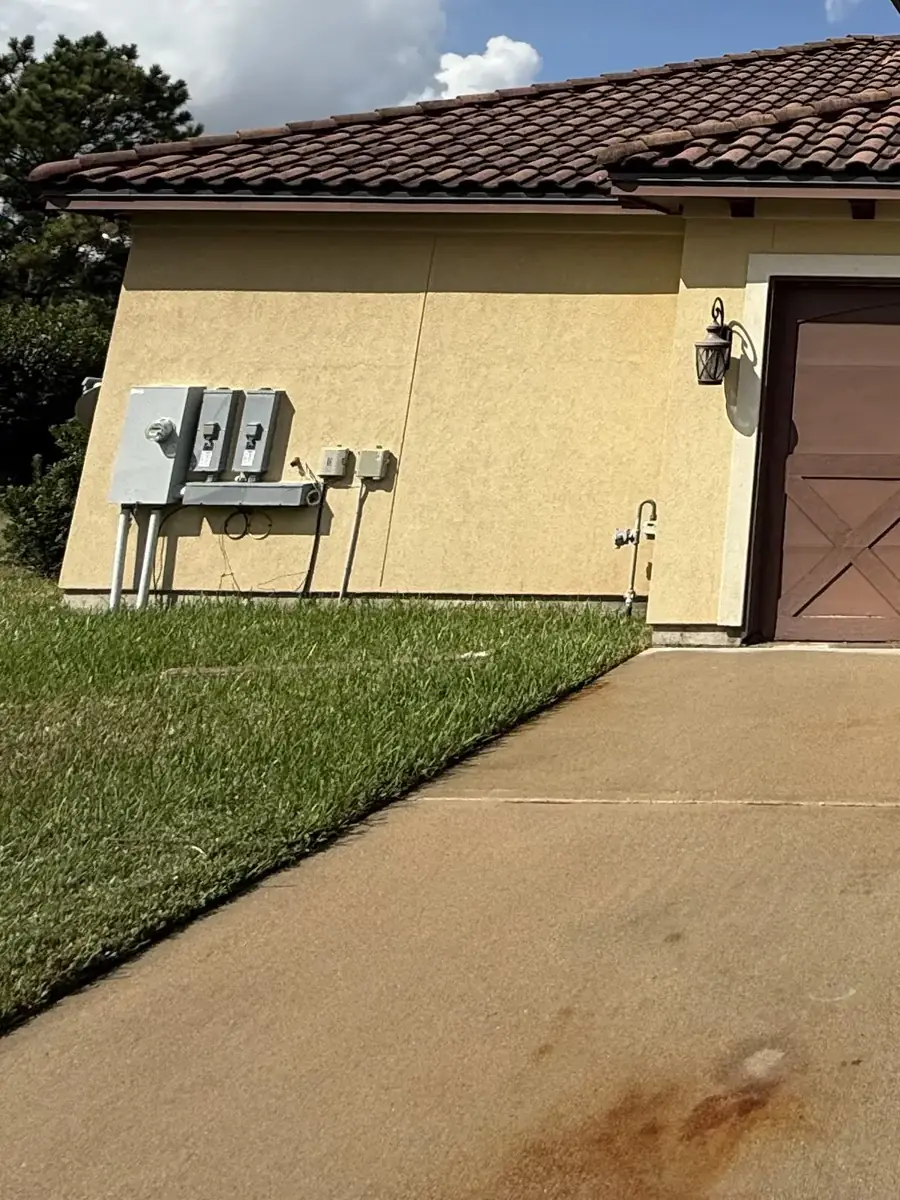
Orange stains are one of the most common things Houston homeowners ask us about. They show up as fan-shaped marks where sprinklers hit the driveway, orange streaks on stucco and brick, and little orange dots after the lawn is fertilized. Here's where they come from, what removes them, and how to keep them away.
What causes rust stains on concrete?
| What it looks like | Likely cause |
|---|---|
| Orange fans or bands where sprinklers hit | Sprinklers fed by well water with high iron |
| Orange streaks low on stucco, brick or fences | Sprinkler overspray hitting the walls |
| Small orange dots across the driveway | Granular fertilizer left on the concrete |
| Rings or drip marks | Metal furniture, planters, grills or tools |
| Drips in parking spots | Vehicles, trailers or batteries |
Irrigation rust is the big one. Plenty of Houston-area homes and neighborhoods irrigate with well water, and well water is often high in iron. Every time the sprinklers run, a little iron lands on the concrete and oxidizes. It builds up slowly, so many homeowners don't notice until the driveway is deep orange.
Why pressure washing doesn't remove rust
Pressure washing removes things sitting on top of a surface, like dirt, algae and mildew. Rust is different. It's iron oxide that has soaked into the pores of the concrete. Water and pressure can't dissolve it, and bleach-based cleaners that work on mildew don't work on rust.
Trying to blast rust out with high pressure usually just etches the concrete around the stain and leaves surface marks, while the orange stays.
How rust stains are removed
Rust needs a cleaner made for rust. These are acidic cleaners that react with the iron and lift it out of the surface so it can be rinsed away. The process looks like this:
- Clean the surface first. Dirt and algae on top can block the cleaner from reaching the stain, so the area is usually cleaned first.
- Protect plants and lawn. Acidic cleaners can harm grass and plants, so landscaping is wet down and protected.
- Apply the rust cleaner. The cleaner is applied evenly to the stained areas, not just the darkest spots, so the finish looks even.
- Let it work, then rinse. The stain dissolves as the product works. Heavy stains may need a second application.
- Rinse thoroughly. Everything is flushed well with water, including nearby plants.
We use a rust-specific cleaner for this, and it can be done on its own or in the same visit as a driveway, house or patio cleaning. Most rust stains come out completely. Very old or deep stains can leave a faint shadow, and we'll tell you what to expect before we start. See our rust removal page.
Can I remove rust stains myself?
You can, but be careful. Some DIY guides recommend muriatic (hydrochloric) acid. Family Handyman's guide, for example, uses a diluted hydrochloric acid product and warns that it's strong enough to require rubber gloves and eye protection, and that the runoff killed grass near the slab.
Before you try it yourself, know the risks:
- Strong acids can etch concrete, leaving a rough, lighter patch that looks worse than the stain.
- Acid can damage nearby surfaces, including brick, stucco, natural stone, metal and car paint.
- Runoff can kill grass and plants if it isn't diluted and rinsed thoroughly.
- Uneven application leaves blotches, with some areas lighter than others.
- Safety gear is a must: gloves, eye protection and good ventilation.
For a small fertilizer spot, a store-bought rust remover made for concrete is a reasonable place to start. Test it in an out-of-the-way spot first. For a whole driveway, stucco walls or natural stone, a professional treatment is usually safer and gives a more even result.
How to keep rust stains from coming back
Removing the stain won't help for long if the sprinklers keep putting iron back down. To stop it at the source:
- Adjust sprinkler heads so they spray the lawn, not the driveway, walls or fence.
- Treat the water. An iron filter or water softener on the irrigation supply can remove the iron. In Family Handyman's example, installing a water softener ended the staining.
- Sweep fertilizer off concrete right after you spread it, before sprinklers or rain hit it.
- Lift metal furniture and planters off concrete with pads or feet.
- Clean new stains early. Fresh stains come out more easily than ones that have built up for years.
Common questions
Most often it's sprinklers running on well water that's high in iron. Each watering leaves a little iron on the concrete, and it slowly turns orange. Fertilizer and metal objects can cause orange spots too.
No. Rust is a chemical stain that soaks into concrete. It needs a rust-specific cleaner that dissolves the iron. High pressure alone can etch the concrete without removing the orange.
No. Bleach works on mildew and algae, not on iron. Rust needs a cleaner made specifically for rust.
Usually, yes. Stucco and brick need extra care because they're more porous and more sensitive to strong acids than concrete, so the cleaner and method have to match the surface.
They will if the source isn't fixed. Adjust sprinklers away from hard surfaces, consider an iron filter on well-water irrigation, and sweep fertilizer off concrete.
Want it done right?
Get a free quote from Naquin Power Washing LLC. $2M insured, 100% satisfaction guaranteed, and free rescheduling for rain.
Get a free quote →